
Pomme : comment améliorer la conservation et réduire le bitter pit ?
For apple growers, successful storage begins long before harvest. While postharvest technologies such as controlled atmosphere storage play a major role in preserving fruit quality, the physiological status of the tree throughout the growing season largely determines the fruit’s storage potential.
Apples destined for long-term storage must combine adequate size, high firmness, balanced mineral composition and strong cell integrity. Achieving these characteristics requires a well-functioning metabolism from flowering until harvest, ensuring continuous energy production, efficient assimilate transport and balanced hormonal regulation.
Consequently, improving storability and reducing physiological disorders such as bitter pit should not be considered only as postharvest objectives, but as the result of integrated orchard management.
Fruit growth and storability are closely connected
Fruit growth depends on the capacity of the tree to produce and allocate carbohydrates throughout the season. During flowering and early fruit development, metabolic activity directly influences fruit set, cell division and subsequent fruit enlargement. When energy production or assimilate transport becomes limiting, fruit growth becomes irregular, resulting in heterogeneous calibers at harvest. TIMAC AGRO emphasizes the importance of supporting tree metabolism from flowering until harvest to maximize the proportion of marketable fruit.
However, maximizing fruit size should never occur at the expense of fruit mineral balance.
Large apples are generally more susceptible to bitter pit because rapid fruit enlargement dilutes calcium concentration within the fruit tissues. Therefore, commercial fruit size and storability should be optimized simultaneously rather than independently.
The physiological origin of bitter pit
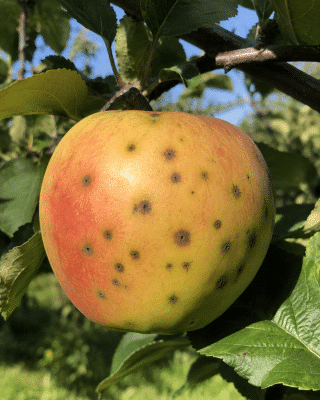
Bitter pit is one of the most important physiological disorders affecting apple storage.
Although traditionally associated with calcium deficiency, current research shows that bitter pit results primarily from an inadequate distribution of calcium within the fruit rather than simply low total calcium content.
Calcium stabilizes cell walls and plasma membranes. When localized calcium concentrations become insufficient, membrane permeability increases, reactive oxygen species accumulate, and cortical cells collapse, producing the characteristic dark corky lesions beneath the skin.
For this reason, maintaining adequate calcium partitioning throughout fruit development is essential for successful long-term storage.
Hormonal regulation: a key driver of fruit development
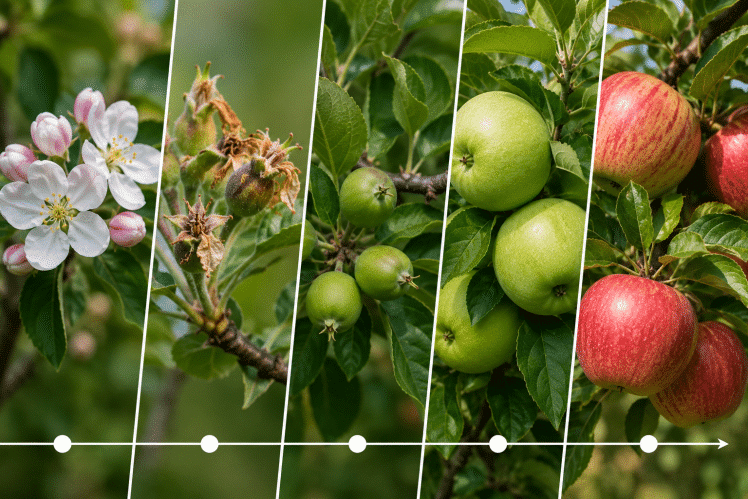
Successful fruit development begins with uniform flowering.
Regular floral bud opening promotes synchronized pollination, homogeneous fruit development and more uniform maturity at harvest. These processes are regulated by endogenous plant hormones, particularly auxins and gibberellins, which drive ovary growth immediately after fertilization. Supporting the tree’s natural hormonal balance during this period helps secure fruit set and promotes regular fruit growth. TIMAC AGRO highlights the importance of sustaining the natural biosynthesis and balance of these hormones during flowering and the first weeks after fruit set.
Nevertheless, vigorous fruit growth must remain balanced with adequate calcium accumulation to avoid increasing bitter pit susceptibility.
Abiotic stress: an underestimated risk factor
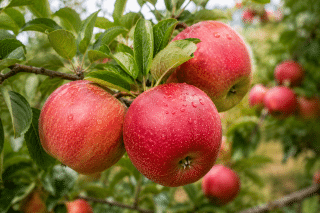
Abiotic stresses occurring during flowering and early fruit development can reduce fruit set, increase fruit drop and impair subsequent fruit quality. According to TIMAC AGRO, maintaining tree physiological activity during these critical stages helps secure the number of marketable fruits.
Later in the season, water deficits or excessive vegetative growth may further compromise calcium transport to developing fruits, increasing the risk of storage disorders.
Orchard practices to improve storability
Reducing bitter pit requires a holistic approach throughout the production cycle.
Key agronomic practices include:
- maintaining balanced vegetative growth;
- avoiding excessive nitrogen fertilization;
- optimizing crop load through appropriate thinning;
- ensuring regular water supply during fruit development;
- implementing season-long calcium spray programs;
- harvesting fruit at optimum physiological maturity.
Together, these practices improve calcium accumulation in fruit tissues while preserving fruit firmness and storage potential.
Supporting tree physiology throughout the season
Long-term storage performance reflects the cumulative effects of tree physiology throughout the season.
Maintaining active metabolism, efficient energy production and balanced hormonal regulation from flowering to harvest supports uniform fruit growth and commercial fruit size.
At the same time, careful management of nutrition and vegetative growth helps ensure adequate calcium distribution, reducing bitter pit incidence during storage.
TIMAC AGRO develops nutritional and biostimulant solutions designed to support tree physiological activity during these critical stages, helping growers optimize both fruit quality and postharvest performance.
By combining balanced nutrition, optimized hormonal regulation, stress mitigation and appropriate calcium management, growers can simultaneously improve commercial yield, fruit quality and storage performance while significantly reducing the incidence of bitter pit.