From Agronomic Challenges to TOP-PHOS Innovation
TOP-PHOS: a breakthrough in the history of phosphorus
Since the discovery of phosphorus in 1669, phosphate fertilization has undergone several major developments, notably with the emergence of superphosphates in the 19th century and ammonium phosphates in the 20th century. However, despite these advances, the agronomic performance of these solutions long remained based on similar principles, without fundamentally transforming their efficiency in the soil.
For more than 165 years, technologies evolved without a real breakthrough, leaving a major challenge unresolved for farmers: the actual availability of phosphorus for crops
It is within this context that TIMAC AGRO developed TOP-PHOS, an innovation that marked a turning point in plant nutrition.
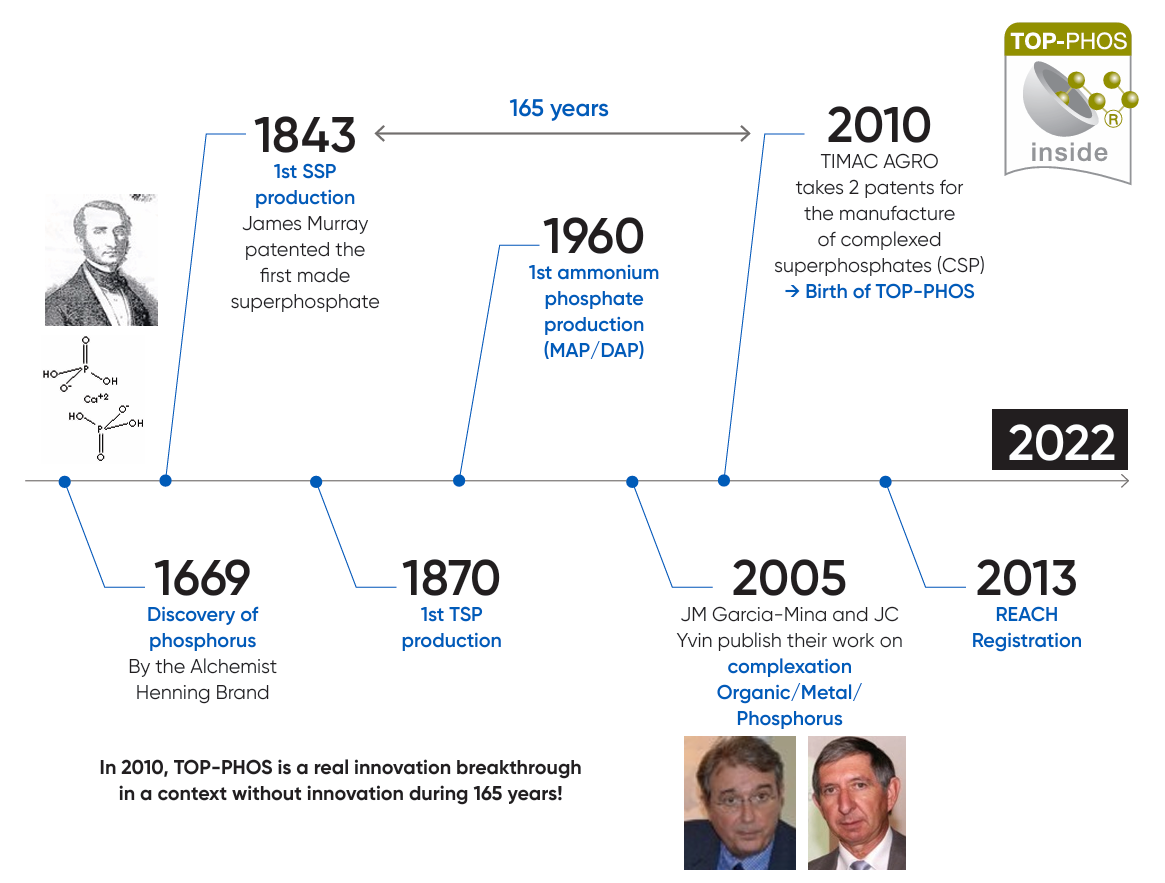
Evolution of phosphate technologies, from the discovery of phosphorus to the TOP-PHOS innovation.
A global agricultural challenge: phosphorus availability
Phosphorus is an essential element for plant development, but its presence in the soil does not guarantee its uptake. In most situations, a large proportion of applied phosphorus quickly becomes unavailable.
This phenomenon is explained by natural chemical reactions. In acidic soils, phosphorus binds with iron and aluminum. In alkaline soils, it reacts with calcium. In both cases, it is transformed into forms that cannot be absorbed by plants.
This challenge, observed across many regions, was particularly significant in Brazil, where up to 70 percent of phosphorus can be fixed in the soil. Identified by TIMAC AGRO field teams, this constraint became the starting point for a new approach to phosphate fertilization
La naissance de TOP-PHOS : de la recherche à l’innovation
The concept of TOP-PHOS was developed in Saint-Malo and first introduced in 2010 during a visit to Brazil involving Daniel Roullier and international scientific experts. The objective was clear: to create a new form of phosphorus capable of remaining available in the soil and efficiently used by plants.
Research conducted on the mechanisms of complexation between organic matter, metals and phosphorus opened the way to this innovation. This work led to the filing of two patents in 2010 for the manufacture of complexed superphosphates, marking the official birth of TOP-PHOS
Technology that transforms phosphorus efficiency
TOP-PHOS is based on a complexed form of phosphorus combining organic and mineral components. This specific structure protects phosphorus from fixation in the soil and maintains it in an available form for a longer period.
Unlike conventional solutions, the phosphorus remains available regardless of soil pH conditions. It is progressively released close to plant roots, ensuring consistent and optimized nutrition throughout the crop cycle.
This approach significantly improves the efficiency of phosphate fertilization by maximizing nutrient use and reducing losses.
Brazil, the starting point of an international success
The launch of TOP-PHOS began in Brazil, a highly demanding market due to its soil characteristics. From the first applications, agronomic performance confirmed the potential of the technology.
After an initial phase of adjustment to optimize recommendations for local conditions, results demonstrated a clear advantage compared to conventional fertilizers
Within four years, TOP-PHOS reached a significant level of adoption, with more than 100,000 tons commercialized. This momentum continued with sustained growth driven by consistent field results
Today, Brazil represents nearly 70 percent of global TOP-PHOS sales, highlighting the relevance of this innovation in high-constraint agronomic environments
Measurable performance in the field
Field trials and demonstrations confirm the benefits of TOP-PHOS across various crops and conditions.
For example, soybean trials have shown an average yield increase of 11 percent, equivalent to +0.39 t/ha, demonstrating the technology’s ability to improve phosphorus use efficiency
Additional references also highlight yield gains in crops such as wheat and rapeseed, along with an overall improvement in fertilization efficiency.
These results reflect better utilization of applied phosphorus and a direct impact on farm economic performance.

Average yield gain observed with TOP-PHOS on 127 soybean trials (+11 percent, +0.39 t/ha).
Global expansion driven by TIMAC AGRO expertise
The success of TOP-PHOS is based on a comprehensive approach combining scientific innovation, technical support and close proximity to farmers.
From its launch, TIMAC AGRO mobilized its teams, partners and agricultural stakeholders through dedicated programs. Initiatives such as the TOP-PHOS Expeditions enabled knowledge sharing, team training and validation of performance under real farming conditions
This collaborative approach accelerated the adoption of the technology and established it as a reference across multiple markets.
A technology deployed worldwide
Today, TOP-PHOS is produced in 11 TIMAC AGRO industrial sites and marketed in more than 27 countries. Its continued growth reflects its ability to meet farmers’ needs across diverse agronomic contexts
Beyond performance, this technology supports a more sustainable agriculture. By improving phosphorus use efficiency, a limited resource, it helps optimize inputs, reduce soil losses and strengthen overall system performance.

TOP-PHOS, a technology deployed worldwide.